


Maximum altitude: 2000 meters
Mounting method: TH35-7.5 DIN rail mounting
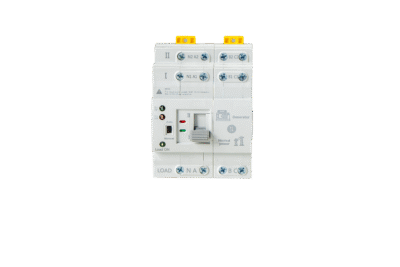
|
Complies with standards
|
IEC60947.3,GB14048.3
|
Rated Insulation Voltage (Ue)
|
500V
|
|
Frame current (lm)
|
63A
|
Rated Operating Voltage (Ue)
|
230V(2P),400V(4P)
|
|
Rated Current (le)
|
32,40,50,63A
|
Number of Poles
|
2P, 4P
|
|
Rated Operating Frequency
|
50/60Hz
|
Rated Impulse Withstand Voltage (Uimp)
|
6kV
|
|
Mechanical life
|
10,000 cycles
|
Electrical life
|
2,000 cycles
|
|
Rated short-time withstand current (LCW)
|
12le/1s
|
Rated short-circuit making time (LCM)
|
20le/1s
|
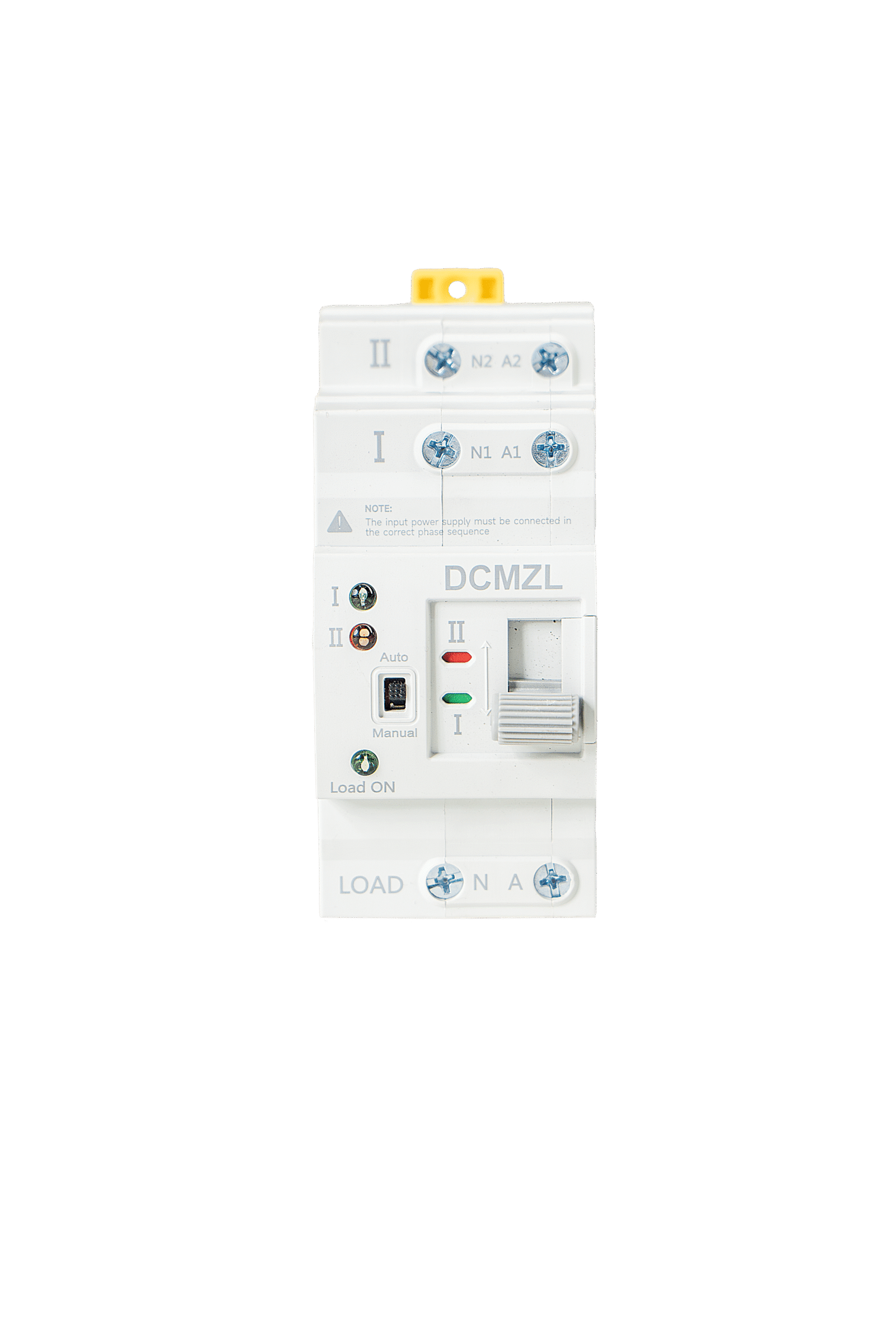
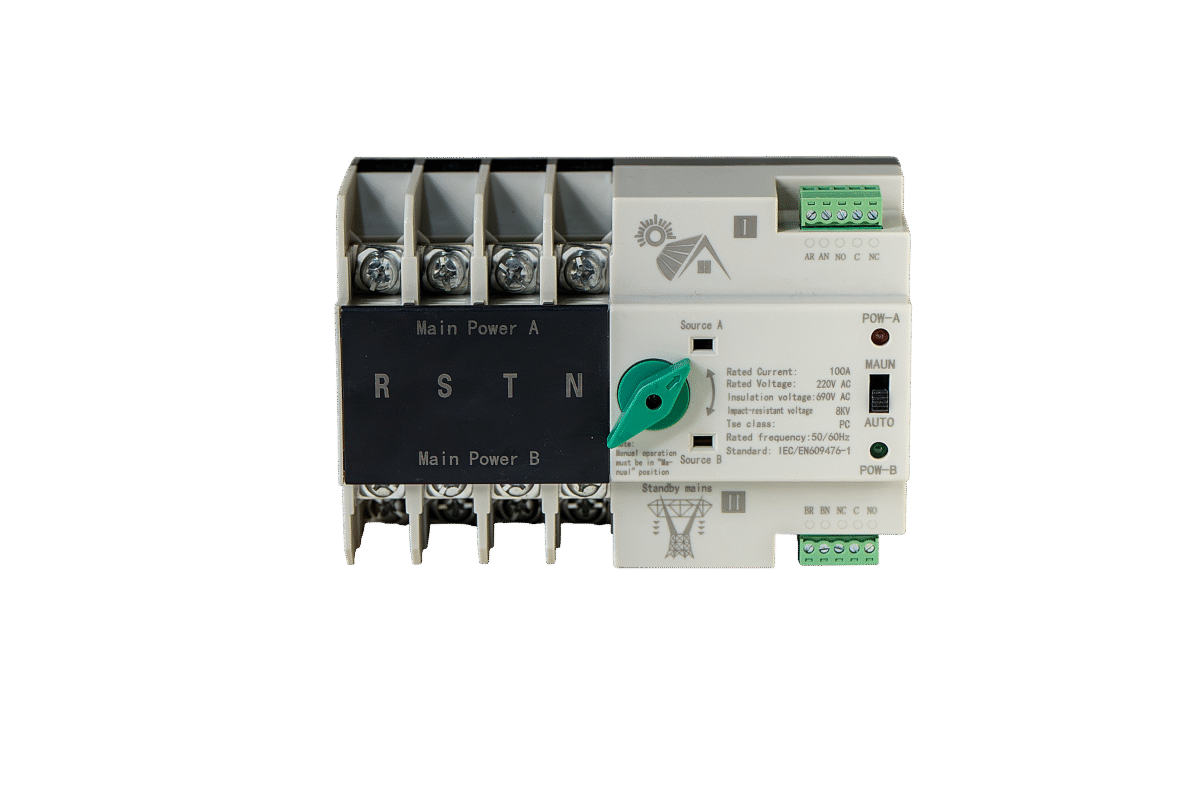
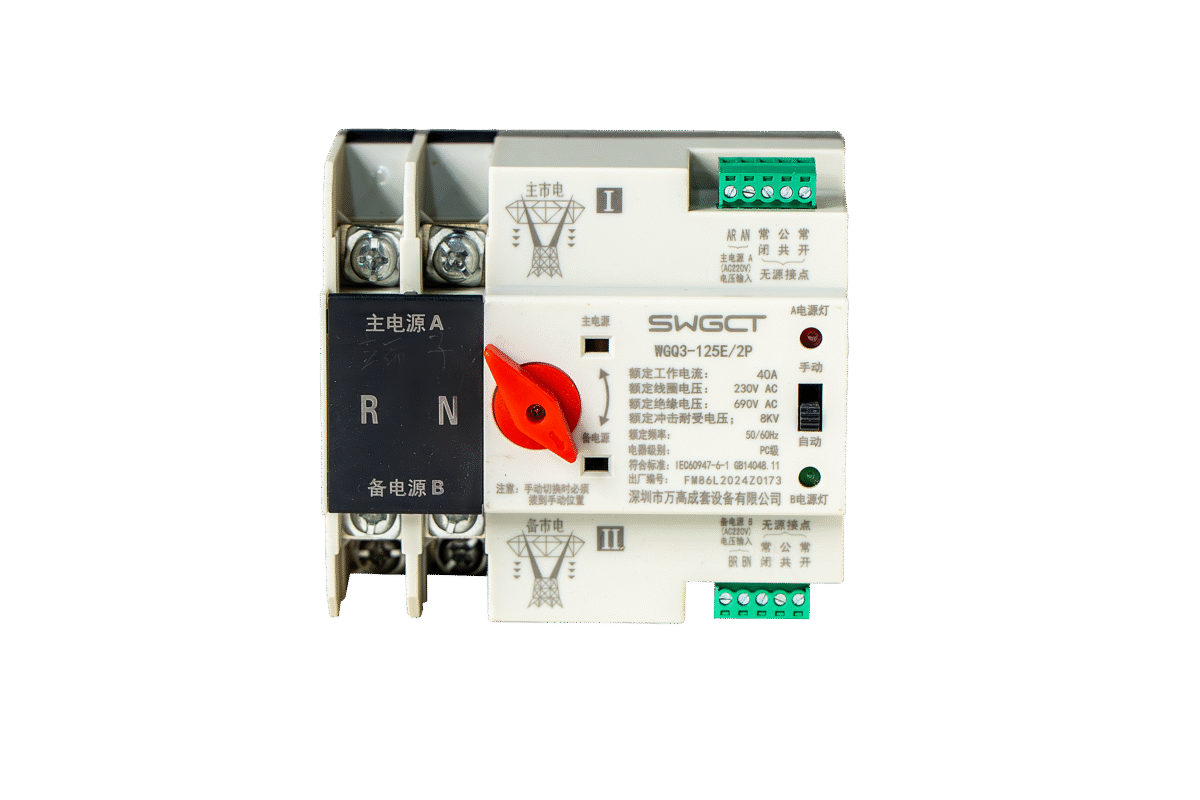
The Miniature Power Transfer Switch (MTS) represents a significant evolution in power management technology, distilling the essential functionality of a full-sized Automatic Transfer Switch (ATS) into a highly compact, space-saving format. Engineered specifically to address the modern constraints of limited space in residential, small commercial, and integrated equipment applications, the MTS offers a robust, reliable, and cost-effective solution for ensuring seamless power continuity.
The Imperative for Compact Power Redundancy
In today’s electrically dependent world, power continuity is not merely a convenience but a necessity. Critical loads—ranging from residential medical equipment and security systems to small commercial servers and telecommunications relays—demand uninterrupted power. Traditional transfer switches, while effective, often require significant enclosure space, presenting a logistical challenge in densely packed electrical rooms or inside appliance chassis. The Miniature Power Transfer Switch directly solves this issue, providing high-reliability dual-source management while minimizing the installation footprint.
Core Functionality and Operation
The primary role of the MTS is to manage and switch the electrical load between two independent power sources: typically the Normal Source (the main utility grid) and the Emergency Source (a backup generator, battery inverter, or secondary feed).
-
Source Monitoring: The switch continuously monitors the voltage and frequency of the Normal Source.
-
Failure Detection: Upon detecting a voltage drop, phase loss, or complete failure of the Normal Source, the control logic is activated.
-
Transfer Initiation: A rapid and safe transfer sequence is initiated, disconnecting the load from the failed Normal Source.
-
Emergency Connection: The load is quickly connected to the Emergency Source, restoring power to the critical circuits.
-
Restoration and Retransfer: When the Normal Source is confirmed stable and available for a set period, the MTS automatically (or manually, depending on the model) retransfers the load back to the Normal Source and shuts down the emergency supply.
This precise, controlled operation is vital for protecting sensitive electronics from sudden power fluctuations and prolonged outages.
Engineered for Safety and Compliance
Despite its miniature dimensions, the MTS does not compromise on safety. A core feature is its comprehensive interlocking mechanism:
-
Mechanical Interlocking: This physical barrier ensures that the contactors for the Normal and Emergency sources cannot be closed simultaneously. This is the ultimate safeguard against short circuits and the dangerous condition of back-feeding power into the utility grid, which could pose a risk to utility workers.
-
Electrical Interlocking: Control circuitry provides a secondary, fail-safe layer of protection, preventing simultaneous closure even in the event of a mechanical fault.
Furthermore, the design often incorporates high-quality, high-speed switching contacts capable of handling the inrush currents associated with motor loads, ensuring longevity and reliable operation over thousands of cycles. Compliance with relevant international standards (such as IEC or local equivalents) is essential, guaranteeing that the switch meets strict criteria for performance and safety.
Technical Advantages of the Miniature Format
The key differentiation of the MTS lies in its form factor, which delivers significant practical benefits:
-
Space Optimization: The compact design allows for installation in standard DIN rail enclosures or small control cabinets, making it perfect for integration into existing systems or new installations with limited space.
-
Reduced Wiring Complexity: By integrating the control and power switching elements into a single, pre-wired unit, the MTS simplifies installation, reduces labor time, and minimizes the potential for wiring errors.
-
Versatile Application: While often associated with residential use (e.g., small off-grid solar systems, critical home circuits), the miniature size makes it highly suitable for Original Equipment Manufacturers (OEMs) who need to incorporate redundancy within their products, such as telecommunication racks or specialized machinery.
-
Cost Efficiency: The streamlined manufacturing and installation process often translate into a lower total cost of ownership compared to assembling separate components (contactor, breaker, and ATS controller).
Ideal Application Scenarios
The Miniature Power Transfer Switch is the go-to solution for applications that demand high reliability in a small footprint:
-
Residential Backup Systems: Ensuring continuous power for heating, refrigeration, or essential security systems.
-
Small Commercial Units: Maintaining operation of cash registers, lighting, and networking equipment in retail or small office environments.
-
Telecommunications and IT: Providing redundancy for remote transmission sites, cellular towers, or network closets.
-
Integrated Machinery: Built directly into equipment like automated manufacturing cells or specialized instrumentation where external power management is impractical.
Conclusion
The Miniature Power Transfer Switch is more than just a smaller component; it represents a focused engineering solution to a persistent problem in electrical distribution. By offering high-speed, safe, and reliable automatic power transfer in a compact form, it empowers installers and end-users alike to achieve robust power redundancy without the spatial or budgetary overhead of traditional systems. It is the intelligent choice for securing critical loads in a rapidly modernizing and space-constrained world.
Q&A
Miniature Power Transfer Switch Q&A
Q1: What is the defining feature of a Miniature Power Transfer Switch (MTS)?
A1: The defining feature is its highly compact size (miniature footprint). It integrates all the essential functions of an Automatic Transfer Switch (ATS) into a device designed to fit easily onto a DIN rail or inside small distribution boards, making it ideal for applications with limited installation space.
Q2: Does the MTS operate automatically or require manual intervention?
A2: Most modern MTS models are designed for Automatic Operation. They continuously monitor the primary power source and automatically switch the electrical load to the backup source upon failure, and then switch back when the primary source is stable. Some versions may also offer a manual override feature.
Q3: What are the two power sources that the MTS typically manages?
A3: The MTS manages switching between the Normal Source (usually the main utility grid) and the Emergency Source (typically a backup power source like a small standby generator, battery system, or inverter).
Q4: How does the MTS ensure safety, especially regarding back-feeding?
A4: Safety is guaranteed through robust Mechanical and Electrical Interlocking. This system strictly prevents both the Normal and Emergency power sources from being connected to the load simultaneously, thereby eliminating the risk of short circuits and dangerous back-feeding into the utility grid.
Q5: Where are Miniature Power Transfer Switches most commonly used?
A5: Due to their small size, they are widely used in:
-
Residential Backup Systems (for essential home circuits).
-
Small Commercial Units and Kiosks.
-
Integrated Equipment and OEM applications (like telecommunications cabinets).
-
Small Solar/Inverter Systems where space in the enclosure is limited.




Valoraciones
No hay valoraciones aún.