


Types of Circuit Breakers: Complete Guide to Electrical Protection Solutions


Introduction: Understanding Types of Circuit Breakers
Types of Circuit Breakers are essential components in modern electrical systems because they protect equipment, buildings, and people from electrical faults. Different circuit breaker types are designed for specific applications, such as residential power distribution, commercial buildings, industrial facilities, and high-voltage networks.
When electrical systems experience overloads, short circuits, or leakage currents, circuit breakers automatically interrupt the power supply to prevent damage. Choosing the correct electrical protection device improves system reliability, reduces maintenance costs, and enhances overall safety.
According to electrical safety standards from organizations such as the International Electrotechnical Commission, selecting appropriate protection equipment is an important part of electrical system design.
Why Different Types of Circuit Breakers Are Important
Electrical loads vary significantly between applications. A small residential lighting circuit does not require the same protection level as a large industrial motor system.
Different breaker designs provide different advantages:
- Protection against overload currents
- Short circuit protection
- Equipment safety
- Improved electrical reliability
- Reduced downtime
Understanding the characteristics of each breaker helps engineers and users select the most suitable solution.
Main Types of Circuit Breakers Explained
MCB: One of the Most Common Circuit Breaker Types
A Miniature Circuit Breaker (MCB) is widely used in homes, offices, and small commercial buildings.
Features of MCB Electrical Protection Devices
MCBs are designed for low-current applications and automatically disconnect circuits when abnormal current conditions occur.
Main advantages include:
- Compact size
- Easy installation
- Fast fault interruption
- Low maintenance requirements
Common Applications of MCB
MCBs are commonly installed in:
- Residential distribution boards
- Lighting circuits
- Small appliances
- Office electrical systems
For more information about electrical protection products, you can also visit the official resources from Schneider Electric circuit breaker solutions.
MCCB: Heavy-Duty Types of Circuit Breakers for Industry
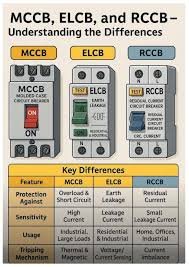
Molded Case Circuit Breakers (MCCBs) are designed for higher current applications where stronger protection is required.
Advantages of MCCB Circuit Breaker Types
Compared with smaller breakers, MCCBs provide:
- Higher current capacity
- Adjustable protection settings
- Greater breaking capacity
- Better industrial performance
Industrial Applications of MCCB
MCCBs are commonly used in:
- Manufacturing plants
- Data centers
- Power distribution systems
- Large commercial buildings
For industrial circuit breaker solutions and electrical protection products, you can explore:
RCCB and RCBO: Safety-Focused Circuit Protection Devices
RCCB Types of Circuit Breakers for Leakage Protection
Residual Current Circuit Breakers (RCCBs) protect people from electric shock by detecting leakage currents.
They are commonly used in:
- Residential buildings
- Public facilities
- Outdoor electrical systems
RCBO Combination Protection Devices
RCBO combines overload protection and leakage protection in one device.
Benefits include:
- Space saving
- Improved safety
- Independent circuit protection
ACB: Advanced Types of Circuit Breakers for Large Systems
Air Circuit Breakers (ACBs) are mainly used in large electrical installations.
Features of ACB Power Protection Equipment
ACBs provide:
- Very high current ratings
- Reliable fault interruption
- Advanced monitoring functions
Where ACBs Are Used
Typical applications include:
- Power stations
- Large factories
- Main distribution panels
Comparison of Different Circuit Breaker Types
| Circuit Breaker Type | Main Application | Current Range | Protection Feature |
|---|---|---|---|
| MCB | Homes and offices | Low current | Overload and short circuit |
| MCCB | Industrial systems | Medium to high current | Adjustable protection |
| RCCB | Safety protection | Various ratings | Leakage protection |
| RCBO | Modern buildings | Low to medium current | Combined protection |
| ACB | Large power systems | High current | Advanced fault control |
How to Choose the Right Types of Circuit Breakers
Selecting suitable protection equipment depends on several factors.
1. Electrical Load Requirements
Analyze:
- Voltage level
- Current demand
- Equipment characteristics
2. Application Environment
Different locations require different solutions:
- Residential → MCB
- Commercial → MCCB or RCBO
- Industrial → MCCB or ACB
3. Safety Requirements
Consider:
- Fault protection needs
- Maintenance requirements
- Local electrical regulations
Circuit Breakers and Modern Electrical Systems
Modern electrical networks require reliable protection devices that can handle increasing energy demands.
Advanced circuit breaker technologies now include:
- Smart monitoring
- Remote operation
- Digital protection systems
- Energy management functions
These improvements help businesses reduce operational risks and improve energy efficiency.
Internal Links for Better Electrical Knowledge
To improve your understanding of electrical products, explore these related resources:
- Circuit breaker products:
https://swgct.net/product - Electrical protection solutions:
https://swgct.net/product-category/circuit-breaker/
Common Mistakes When Selecting Circuit Breakers
Many users make mistakes when choosing protection devices.
Common problems include:
- Selecting incorrect current ratings
- Ignoring breaking capacity
- Using residential breakers for industrial loads
- Not considering future expansion
Proper planning ensures better performance and longer equipment life.
Future Development of Circuit Breaker Technology
The future of circuit protection is moving toward smarter solutions.
Key trends include:
- IoT-connected breakers
- Automated fault detection
- Digital energy monitoring
- Intelligent power management
These innovations will make electrical systems safer and more efficient.
FAQs About Types of Circuit Breakers
1. What are the main types of circuit breakers?
The main types include MCB, MCCB, RCCB, RCBO, and ACB. Each type is designed for different electrical protection requirements.
2. Which circuit breaker is best for home use?
MCB and RCBO are commonly used in residential applications because they provide reliable protection for household circuits.
3. What is the difference between MCB and MCCB?
MCB is designed for lower current applications, while MCCB provides higher capacity and adjustable protection for industrial systems.
4. Why are RCCBs important?
RCCBs help prevent electric shock by detecting leakage currents and disconnecting unsafe circuits.
5. Which breaker is used in factories?
Industrial facilities commonly use MCCBs and ACBs because they can handle higher electrical loads.
6. How do I select the correct circuit breaker?
Selection depends on current rating, application type, safety requirements, and system design.
Conclusion: Choosing the Right Types of Circuit Breakers
Understanding Types of Circuit Breakers helps businesses and individuals create safer and more reliable electrical systems. From compact MCB solutions for homes to powerful MCCBs and ACBs for industries, every breaker serves a specific purpose.
Choosing the correct protection device improves safety, reduces equipment damage, and ensures stable electrical operation.
For professional circuit protection products and solutions, visit: